
How Pico Rivera Residents Are Found
A name, street, or date leads to a different record trail in Pico Rivera. The city keeps its own council actions, permit lists, business reports, and ordinances in the City Clerk’s Laserfiche Online Records Library. Los Angeles County holds deeds, assessment data, voter files, and certificates. The Superior Court of California, County of Los Angeles, handles civil, family, probate, and criminal case access because Pico Rivera has no separate municipal court. Library shelves add a historic layer that can reach back before the city incorporated.
Ownership is not the same as occupancy. The assessor can tie an AIN, or Assessor Identification Number, to a parcel and a recorded owner, while a voter record can show a registration connection subject to strict use rules. A permit can date work at an address, but an applicant or contractor is not proof of residence. A city directory entry can place a household near a publication date, yet a missing name may reflect a skipped canvass, a spelling change, or an older place label.
- Start with the Los Angeles County Assessor Portal when an address or AIN is known. Save the situs address, legal clues, year built, and assessment history.
- Use the Recorder’s name and recording-year index when the question concerns a deed, lien, map, or other recorded instrument. The index is not searchable by street address or AIN.
- Use the Los Angeles County voter status tool for a person’s own registration check. A voter file is a qualified-use record, not an open street browser.
- Search the city’s Laserfiche library for permits, minutes, ordinances, reports, and new-business lists tied to an address or date.
- For earlier households, ask Norwalk Library staff for Californiana material and search Pico, Rivera, Whittier, and county suburban labels.
- When a record is identifiable but not online, send a focused California Public Records Act request to the agency that actually holds it.
Offices Behind Pico Rivera Resident Records
The county and city divide the work. The Los Angeles County Registrar-Recorder/County Clerk is the main source for real-estate instruments, county vital records, marriage licenses, fictitious business names, and related filings. The Los Angeles County Assessor Portal is the address-first parcel door. The LA County elections lookup is for a voter checking their own status, while the court and library routes answer different questions.
Los Angeles County RR/CC
Recorder and County Clerk
Deeds from 1850, vital records, FBN filings
Recorder services linked above
Los Angeles County Assessor
AIN, address, legal, map, and assessment search
Current roll and reported assessment history
Assessor Portal linked above
Pico Rivera City Clerk
City actions, permits, reports, and CPRA route
Laserfiche archive and focused requests
City records management route
For a county record, asking the City Clerk to create a list will not work. The city expressly redirects birth, death, marriage, and private-property deed questions to the county. That division is one of the most useful facts in the Pico Rivera residents directory: it prevents a long request from reaching an office that never held the record.
Why Pico Rivera Assessor Search Comes First
An address is the strongest starting clue for a present parcel. The Assessor Portal’s Basic Search accepts an AIN or address through an autocomplete field. Legal Search can expose tract, map-book, page, and parcel components where available. Map Search lets a reader select a parcel. The resulting profile can show situs address, property type or use, assessed land and improvement values, tax-rate area, year built, building characteristics, legal description, map, and assessment history. It does not act as a countywide resident-name directory.
The difference between a situs address and a mailing address matters. Situs means the physical parcel. Mailing means where tax correspondence goes, which may be elsewhere. A mismatch can suggest an owner connection outside the parcel, but neither a match nor a mismatch proves who sleeps at the address. Assessment values are not guaranteed sale prices, and the portal may limit owner or address display for protected situations.
| Assessor mode | Input | What it returns |
|---|---|---|
| Basic Search | AIN or address, then a suggested match | Parcel profile and assessment facts |
| Legal Search | Tract, map-book, page, parcel, where exposed | Legal-description route |
| Map Search | Pan, zoom, and parcel selection | Parcel location and map context |
| Search button | Required after the selected match | Submitted result |
The Assessor Portal entry screen shows the address-first path. The parcel number then becomes the bridge to county tax information, GIS layers, permits, and a Recorder name/year search. The Property Tax Portal adds bill and payment context, but it still does not supply an occupant list.
The public record quirk is simple: the Recorder cannot search a deed by address or AIN. Convert the address into a current owner and an estimated recording year, then carry that name to the Recorder index. This AIN-to-name conversion is the key step that separates a useful Pico Rivera directory search from a dead end.
Note: An Assessor Portal result identifies a parcel and assessment connection, not every person who lives at the situs address.
For a visual check, the county parcel search is the relevant public entry point.
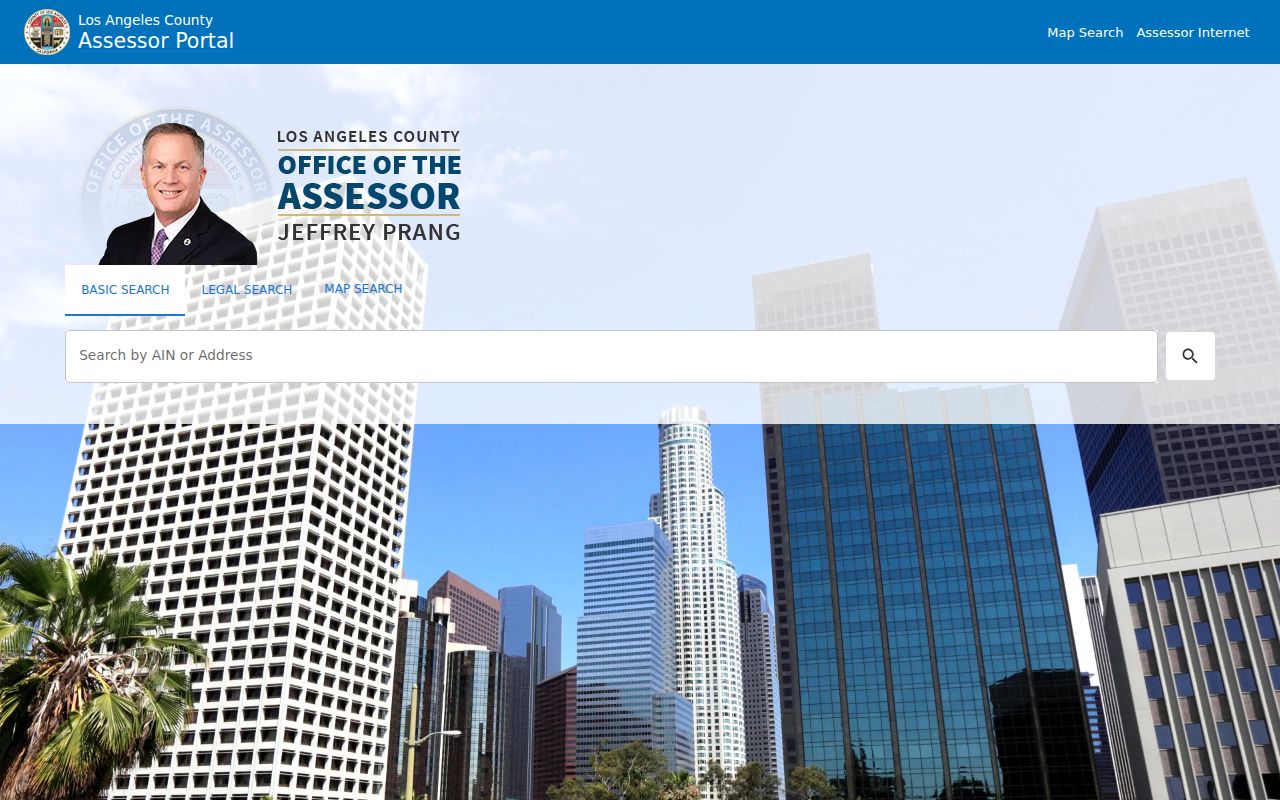
The parcel screen is most useful when its AIN and legal clues are saved before moving to another record system.
Pico Rivera City Records and Permits
The Pico Rivera Laserfiche Online Records Library supplies a city-level directory of documents rather than a private-resident roster. Its repository and document archive hold ordinances, resolutions, minutes, monthly building-permit reports, and new-business lists. Search can use text and metadata, then open or download a document. Exact button and field labels are dynamic, so an address search should try street variants, an AIN when the document includes it, a business name, and a date.
Building and Safety records can place a project at a parcel. A permit may show issue date, project address, work description, contractor or applicant, and valuation. That can date an alteration or a new tract, but the applicant is not proof of residence. Monthly reports are snapshots. Older detail may require a focused request, and code-enforcement material can be withheld when release would expose an active investigation or complainant.
The city says the newest monthly building-permit and new-business reports appear around the tenth of each month. City Clerk records management is also the CPRA route for existing city writings, and the city describes a ten-calendar-day determination period. That is a decision deadline, not a promise that a full production will arrive in ten days. Requests should name the record type, address, date range, and desired format.
The online library’s city context is visible through the official records-library portal.
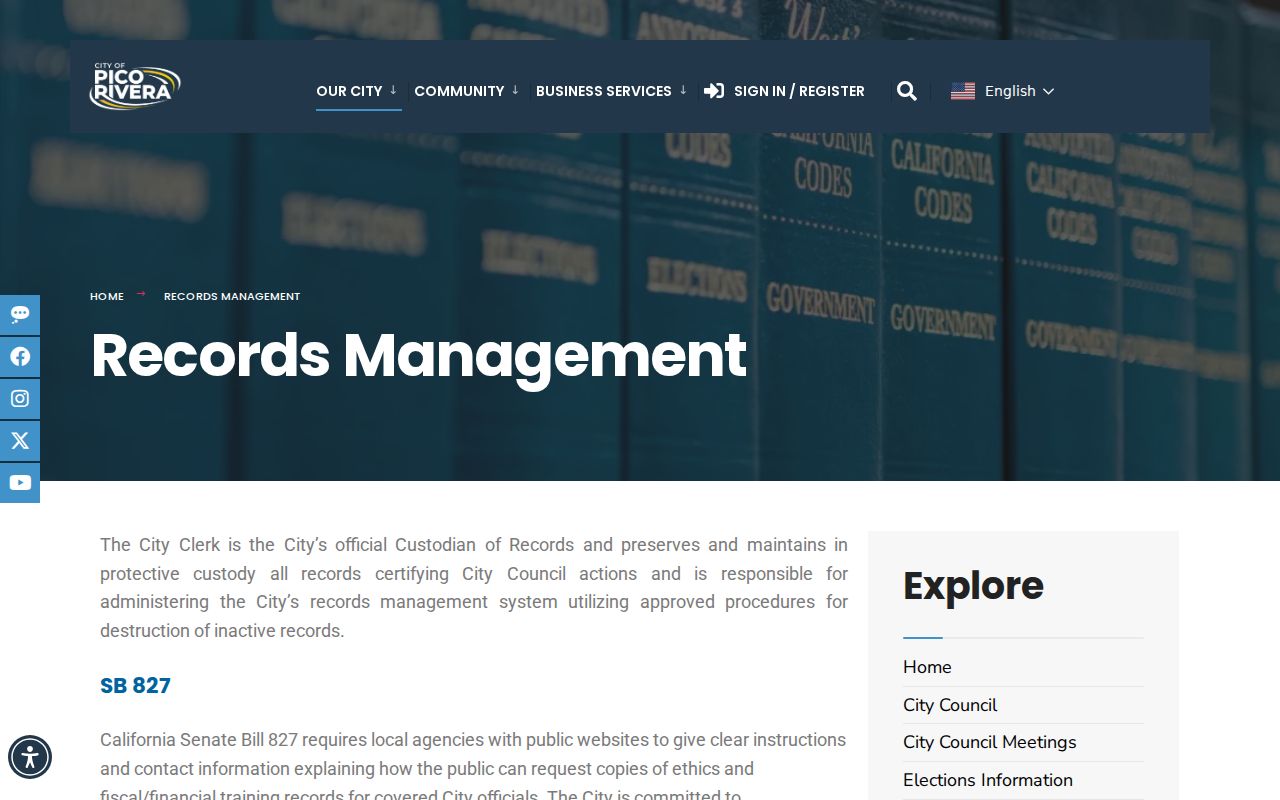
City records can connect an address to public activity, but a permit trail must stay distinct from a residence claim.
A second view of the Laserfiche library helps locate the retrieval guide and report series.
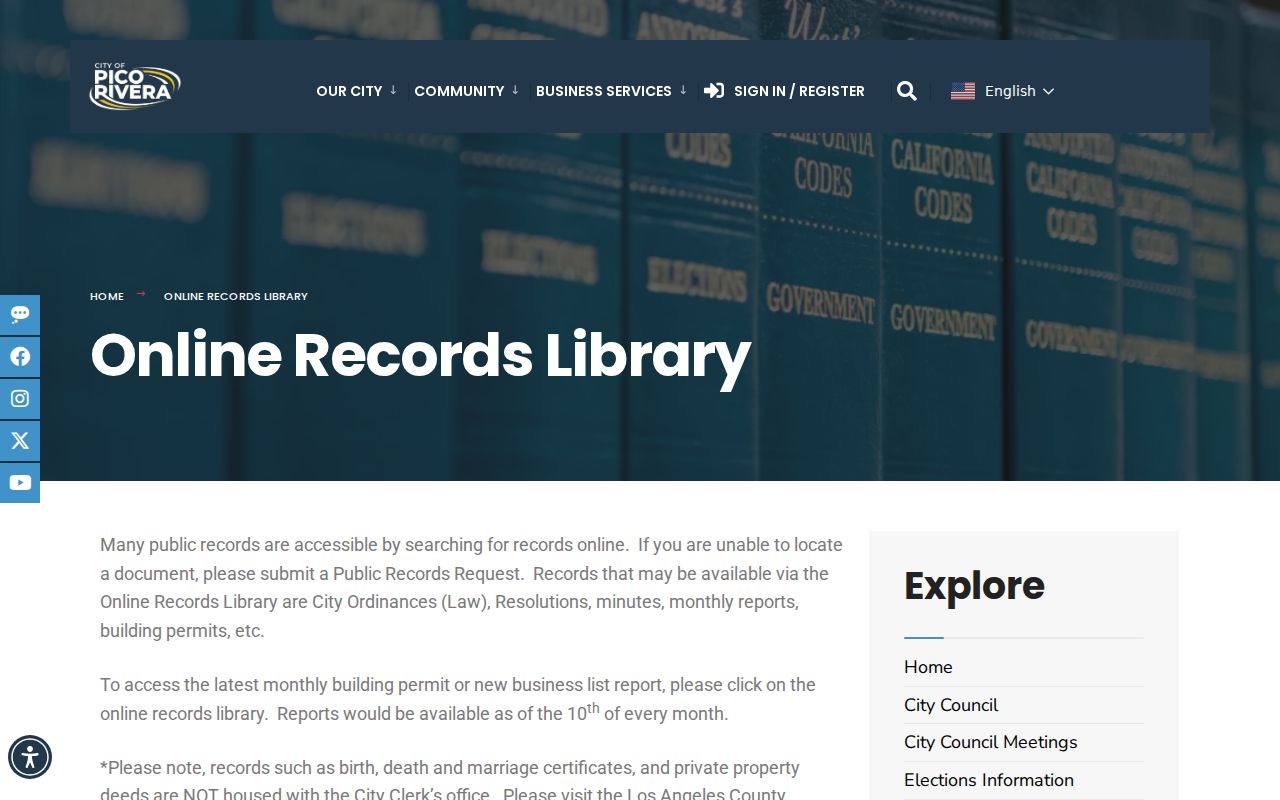
For a birth, death, marriage, or private deed, leave the municipal archive and go to Los Angeles County RR/CC instead.
Pico Rivera’s Current Resident Sources
No single current roll lists every Pico Rivera household. Each source answers a narrower question. The assessor and Recorder relate people to land or documents. The elections system confirms a person’s own registration and offers qualified file access. City reports identify public activity at an address. Court, business, license, and unclaimed-property systems add connections that may be useful but should never be mistaken for proof of present residence.
| Source | What It Can Connect | Keeper | Access |
|---|---|---|---|
| Assessment parcel | Owner or parcel facts | Los Angeles County Assessor | Address/AIN portal |
| Recorded index | Deed, lien, map, and party roles | LA County RR/CC Recorder | Name/year office index; copies paid |
| Voter status | Personal registration and election details | LA County Registrar-Recorder | Identity-gated self-lookup |
| City Laserfiche | Permits, reports, actions, businesses | Pico Rivera City Clerk | Online library or CPRA |
| Court case | Party role and case events | Los Angeles Superior Court | Case number free; name modes may charge |
| Library collection | Historic names and addresses | LA County Library | Catalog and staff retrieval |
Use the source that matches the fact. A current owner question starts with the assessor. A former owner question moves from the assessor to a Recorder name/year search. A historical household question may need the library and census. A person with a court matter requires a case number or a paid court name search, plus identity checks. A name in a commercial profile is only a lead until an official custodian confirms it. The current Pico Rivera residents directory is therefore a set of narrow sources, not one master roll.
Los Angeles Court Records by Name
Pico Rivera cases run through the Los Angeles Superior Court. The LASC Case Access system accepts a known case number for civil, small claims, family, and probate summaries. Separate fee-supported modes search civil, family, and probate party names or criminal defendant names when the case number is unknown. A name match alone is weak. Compare the filing courthouse, case type, dates, party role, business, parcel, or probate relationship.
| Court route | Required clue | Access note |
|---|---|---|
| Case Access | Exact case number | Free summary |
| Case Calendar | Case number | Hearing and department information |
| Party name | Person or organization name | Separate paid civil, family, probate search |
| Defendant name | Criminal defendant name | Separate paid index and identity caution |
| Document images | Eligible case and account or guest route | Limited civil and small-claims coverage |
A case summary can show case number, title, filing courthouse, filing date, case type or status, parties, events, hearings, and a disposition when entered. Criminal and family documents are not posted online in the same way as eligible civil images. A clerk or Archives and Records Center may hold older transferred files. Certified or ordinary copies come from the filing courthouse or the court’s records route.
Federal matters belong to the Central District of California, with docket access through PACER. PACER charges by page under its current schedule. The federal route is separate from LASC and should not be treated as a second view of the same county docket.
See the official Los Angeles Superior Court search page before relying on a result.

The court screen shows why a known case number is a cleaner verification anchor than a broad name search.
Vital Records for Pico Rivera Research
Los Angeles County RR/CC records county births from 1866, deaths from 1877, and marriages from 1852. The California Department of Public Health issues statewide certificates. These dates make the custodian choice clear: earlier life events need parish, cemetery, newspaper, census, or other historical evidence, while county certificates are subject to copy type and eligibility rules.
An informational copy is not an identity document. Authorized birth and death copies require an eligible relationship or statutory role, a sworn statement, and, for mailed requests, the notarization rules on the form. Confidential marriage certificates are closed except to a party or by court order under Family Code section 511. California therefore does not use a simple “open after a set number of years” rule for modern certificates.
| Record | Coverage and keeper | Access distinction |
|---|---|---|
| Birth | LA RR/CC from 1866; CDPH statewide | Authorized or informational copy |
| Death | LA RR/CC from 1877; CDPH statewide | Copy type and eligibility control access |
| Public marriage | LA RR/CC from 1852 | Public certificate route |
| Confidential marriage | County where license issued | Party request or court order |
| Dissolution | Superior Court file; CDPH certificate for specified years | Certificate is not the full decree |
For a county birth appointment, the application asks for the record name, date and place of birth, parents, copy type, identity, relationship, sworn declaration, payment, and contact details. Some years are supplied at the appointment, while other ranges and informational copies are mailed within the county’s stated time. The first-copy fee is nonrefundable and a no-record statement may be issued.
State fees changed on January 1, 2026 under AB 64. CDPH lists certified birth at $31, death at $26, public marriage at $19, and dissolution at $18, while the county birth route lists $34. Verify the live custodian page before ordering. For a birth-parent search, use California’s adoption information and consent process or a court route, not an ordinary certificate order.
Norwalk’s Historical Records Shelf
The strongest local history resource is the LA County Library Californiana Collection at Norwalk Library. It holds more than 24,000 books and over 200 paper or microfilm newspaper and magazine titles. Its scope includes California census schedules from 1850 through 1910, the Los Angeles Star from 1851 through 1879, official city and county histories, and city directories dating from the nineteenth century.
Pico Rivera Library at 9001 Mines Avenue and Rivera Library at 7828 Serapis Avenue provide catalog and database access. The deeper Californiana material is in closed stacks at Norwalk Library, 12350 Imperial Highway, near the RR/CC campus. Contact staff before travel. A collection-level description of city directories does not prove that every year or every Pico/Rivera volume is present.
Search historical names as separate places. Before incorporation, a modern address may be indexed under Pico, Rivera, Whittier, Montebello, or a Los Angeles County suburban label. Ask staff to check the catalog, publisher, edition, coverage statement, and reverse section. FamilySearch’s Los Angeles County catalog can point to land, probate, court, vital, naturalization, and other collections, but image access can vary by login or affiliate library.
The LA County Library local history portal provides the context for interpreting a tract, farm, railroad corridor, or former community name.

Norwalk’s shelf is most valuable when its directory evidence is paired with a county deed, census entry, obituary, or permit date.
Pico Rivera’s Historic Directory Shelf
A historic directory can show a surname, given name or initial, occupation, spouse, address, and sometimes an “h” householder mark, “r” residence or roomer mark, business address, or telephone. A reverse or criss-cross section may move from street and number to subscriber or householder. The exact abbreviation key and publisher control the reading, and a telephone listing may cover a subscriber rather than every adult in a home.
The directory year is evidence of the canvass or edition, not an exact move-in date. A missing entry can mean an omitted household, an unlisted number, a boundary label, a spelling variant, or a year with no local coverage. Pair the entry with a 1950 census household, a deed, a probate file, a newspaper notice, or a city permit before drawing a conclusion about who lived at a place.
Pico and Rivera grew after rail lines arrived in the 1870s. Citrus, avocado, and walnut farming shaped the early landscape. Postwar tract building replaced orchards with numbered lots, schools, and churches in the 1950s. The January 7, 1958 incorporation united the two community names and created city records going forward. That geography explains why an older Pico Rivera residents directory search must use more than the modern city label.
The historical collections are treated in depth in the Pico Rivera directory book route, while current address-keyed records belong in the street directory route. A pre-incorporation Pico Rivera residents directory may use a different community label.
Why Voter Information Is Restricted
The LA County voter status tool is designed for a person to check their own registration, residence or election address, party preference, precinct, districts, ballot information, and participation history. The workflow uses identity details such as name, birth date, and address or ZIP verification. It is not a public browse-by-street resident directory.
Election Code section 2194 limits voter-registration information to election, scholarly, journalistic, political, or governmental purposes as determined by the Secretary of State. LA County’s order route asks for requester and organization details, geographic file, file type, requested fields, purpose, delivery, signature, lawful-use certification, and payment. Published fees are $146 countywide, $54 for a precinct, district, or city, and $39 for each added file. Confidential voters and Safe at Home participants have additional protection.
The official voter lookup is the right path for a personal check.
A dated aggregate report can show city-level registration totals, but it does not expose the names of a neighborhood.
When the Pico Rivera Record Trail Stops
A focused CPRA request is the fallback when a city or county record exists but the public interface does not reveal it. Name the agency, record series, address or person, date range, and desired electronic format. Ask the custodian to help identify a focused set. California Government Code sections 7920.000 and following cover existing writings, but the law does not require an agency to create a new list.
The usual determination period is ten calendar days, with a written extension of up to fourteen days for unusual circumstances. Inspection is generally free, while copy charges are limited to direct duplication cost unless another statute sets a fee. Exempt personal information, voter restrictions, vital-record rules, court seals, juvenile files, DMV data, and Safe at Home protections still apply. A request route cannot override those limits.
Use the narrowest lawful question. Ask for an existing permit list, meeting packet, or record series tied to a date and address. Do not ask an agency to create a resident roster.
For county requests, the RR/CC public-records request route identifies the NextRequest channel and record-specific exceptions. That focused path closes a Pico Rivera residents directory search when the needed document is not online.
Protecting a Pico Rivera Address
California privacy rules affect what a residents directory can lawfully show. Safe at Home gives qualifying survivors and certain threatened workers or public employees a substitute mailing address and mail forwarding. Government Code section 6208.1 and related online-display rules restrict malicious publication and can require removal or nondisclosure after a qualifying demand. A substitute address must never be reverse engineered.
The California Consumer Privacy Act, Civil Code section 1798.100 and following, gives rights to know, access, delete, correct, opt out of sale or sharing, and limit certain sensitive-data uses, subject to exceptions. California’s Delete Request and Opt-out Platform, or DROP, launched in 2026 for one request to more than 500 registered data brokers. The Attorney General reported that mandatory broker deletion begins August 1, 2026. Those rights concern data brokers, not a county deed or voter file that the custodian must retain.
Use the official Safe at Home information, California privacy rights page, and DROP platform for the current process. Public records may be available for lawful research, yet public availability does not permit stalking, threats, intimidation, or harassment.